
Building societies develop regional economies amid bank branch closures
Analysis of branch networks shows how building societies are keeping their branches open, supporting consumers and communities across the country.

-
Share this page

Share this link via
-
-
Copy URL

-
Andrew Gall


 Andrew Gall, Head of Savings & Economics, BSA
Building societies account for 32% of branches, and this rises to 35%* when the recently acquired banks are added into the figures, with over 1,400 branches in total. Just over a decade ago, building societies accounted for just 14% of all branches.
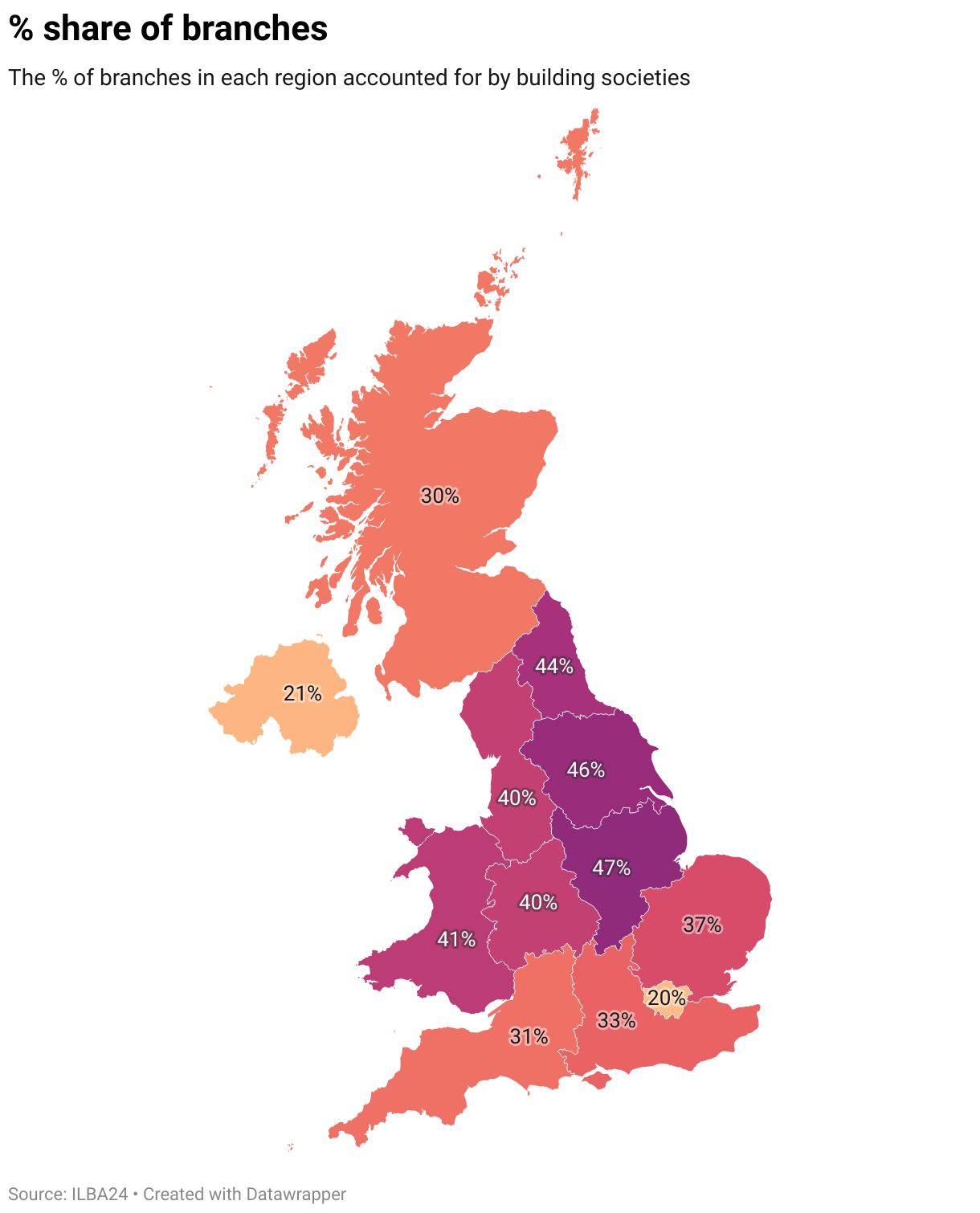
Analysis by branch data specialists at ILBA24 shows that building societies have a particularly high share of branches across many UK regions outside of London.
As the map in Figure 1 shows, in some areas societies account for almost half of branches, with 47% of those in the East Midlands and 46% in Yorkshire and the Humber.
All of today’s building societies were established outside London, and while many operate nationally others still focus on specific regions. Their members value having a branch, and they help to engage the local community, which is often core to a building society’s purpose.
While banks continue to announce branch closures, a recent research report from Whitecap Consulting found that building societies are maintaining their branches, but changing their roles. Branches are evolving into multipurpose spaces, combining operational roles like administration and back-office work with traditional customer-facing services, and more are being made into hubs and resources for the wider community. Some societies are trialling multi-bank kiosks in their branches which enable consumers to deposit and withdraw cash, and access banking services with a range of banks.
Simon Taylor, CEO at the Melton Building Society, is quoted by Whitecap as saying, “Branches are not big income generators. It’s more about supporting our membership and engaging with the community which as a mutual is fundamental to our purpose.”
This regional impact is also reflected in the jobs building societies create. All societies have their headquarters outside of London, with 95% of their employees based outside the Capital. In contrast, ONS data indicates that 43% of people working in banking are based in London.
The Whitecap research also highlights how societies have been investing in the skills of branch staff, describing how employees are now balancing traditional branch responsibilities with back-office and call centre tasks, as well as more complex interactions, such as mortgage and savings advice.
Supporting branches in local communities
A different view of the data shows that building societies are continuing to serve areas with smaller populations when compared to other providers (see table 1).
In smaller towns and communities with less than 25,000 residents, building societies account for 46% of branches.
In medium sized towns (25,000 to less than 100,000 residents) they make up 35% of branches, while in the larger towns and cities (any with a population of 100,000 or more), they account for 30% of branches.
This demonstrates how societies have stuck with their local high streets, while the banks have left them to focus on the larger cities.
Table 1: Building society % share of branches
| Small towns and communities | 46% |
| Small-medium sized towns | 35% |
| Large towns and cities | 30% |
The Government’s recent Financial Services Growth and Competitiveness Strategy highlights the importance of the financial services sector supporting growth across all regions of the country.
Building societies can play a key role in delivering this inclusive growth as they continue to invest in branches across towns and communities and employ workers in all parts of the UK.
* Note: The 35% share reduces to 34% if open or approved Banking Hubs are included, though these are limited to different days for different banks.
You may also be interested in...

-
 Event
Event
- Audit & Taxation
Audit and Accounting Seminar
After another successful event in 2025, and responding to delegate feedback, this year's annual update will take place in London. The full-day e...
.jpg?width=4928&height=3264&ext=.jpg)
-
 Research & Reports
- Audit & Taxation
Audit for growth: Proportionality in audit and reporting
A joint update from the Association of Financial Mutuals and the Building Societies Association

-
 Press Release
- Savings
Young workers face £300 shortfall as money worries hit work
New research by the Building Societies Association for UK Savings Week reveals the financial pressure facing young working adults and suggests that re...