
Guest blog: Could Open Banking help building societies reach more borrowers?
New research conducted by researches at Brunel University of London and the University of Essex, and supported by the Building Societies Association, explores what Open Banking means for building societies and the communities they serve.

-
Share this page

Share this link via
-
-
Copy URL

-
Katie Wise


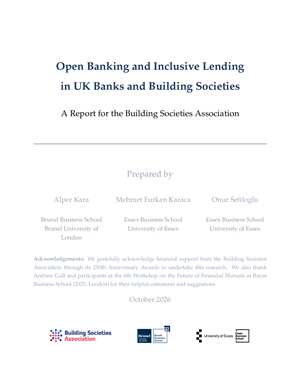 By Alper Kara, Professor of Banking & Finance and Head of Department of Economics, Finance & Accounting, Brunel Business School, Brunel University of London
When someone applies for a mortgage, understanding what they can afford is essential. Open Banking allows customers to securely share their bank account information with authorised providers, with their permission. This can give lenders a clearer picture of income and spending, potentially supporting better lending decisions and access to finance.
But will these benefits reach everyone?
Our research, supported by the Building Societies Association and conducted by researchers at Brunel University of London and the University of Essex, explores what Open Banking means for building societies and the communities they serve.
The report finds that adoption is uneven. Large banks generally have more extensive Open Banking capabilities, while building societies’ engagement remains more limited. Their strengths continue to lie in mortgage lending, trusted customer relationships and local knowledge.
One finding is particularly relevant for the mutual sector. Areas with a stronger building society branch presence tend to have lower use of financial technology. This creates an opportunity for building societies to help customers benefit from digital services, including those who may need more support to use them.
The evidence also shows that lending patterns vary between institutions and regions. Open Banking’s potential to widen access depends on how lenders use it and the circumstances of the communities they serve.
For building societies, practical opportunities include using account information to support affordability assessments and simplify applications. Partnerships with technology providers and shared investment across the sector could help smaller societies develop these capabilities.
Policymakers also have a role in ensuring that smaller lenders can participate and that customers understand and trust how their information is used.
Combining digital tools with the personal service that members value could help building societies extend their reach. Our report explores how this combination could support a more inclusive future for lending.
Download the report
You may also be interested in...
-
 Industry Response
Child Trust Funds - minor changes
We propose that by removing the requirement to provide the child’s address on the CTF annual statement, the safeguarding risk that could arise from it...

-
 Event
Event
- Mortgages & Housing
Smart Property Data: Is Your Mortgage Journey Ready?
A free webinar hosted by BSA Associate, Novus Strategy Smart Property Data means property information that is verified once and reused across the t...
-
Industry Response
- Mortgages & Housing
BSA response to DBT Smart Data multi sector Call for Evidence
The BSA has responded to the Department for Business and Trade's Smart Data multi-sector Call for Evidence. The response focuses on the property and g...